

When a quality issue is identified in healthcare, the first explanation is rarely the complete one.
A medication error occurs. A patient falls despite documented precautions. A deterioration in a patient's condition is recognised, but escalation is delayed. These events tell an organisation what happened, but the first explanation does not necessarily explain why it happened.
Too often, the immediate cause becomes the conclusion: someone selected the wrong medication, a procedure wasn't followed or information wasn't communicated. Corrective action may then focus on the individual rather than examining the conditions that allowed the incident to occur.
The Root Cause Analysis Five Whys technique helps healthcare organisations move beyond symptoms by encouraging teams to ask progressively deeper questions until they uncover the system, process or governance issues surrounding an event.
Used appropriately, the Five Whys is less about finding someone responsible and more about asking a much more useful question: what allowed this incident to happen, and what needs to change to reduce the likelihood of it happening again?
Looking Beyond the Obvious
The strength of the Five Whys lies in its simplicity. Rather than accepting the first explanation for an incident, investigators continue asking "Why?" to explore the factors that contributed to it.
The goal isn't to ask exactly five questions. Some investigations reach the root cause after three questions, while others require six or seven. What matters is moving beyond immediate symptoms and understanding the systems, processes or organisational factors that contributed to the event.
This mindset is particularly important in healthcare.
Consider an investigation that concludes a medication error occurred because a member of staff "selected the wrong medication". That may be factually correct, but it leaves several important questions unanswered.
Why was it possible to select the wrong medication? Were similar products stored together? Were there previous near misses involving the same products? Did existing procedures recognise the risk? Were appropriate controls in place?
Those questions shift the investigation from who made the error towards why the system allowed the error to reach the patient.
Healthcare incidents can also involve multiple interacting factors, so Five Whys should not be treated as a way of forcing every event towards one definitive root cause. More complex incidents may require broader investigation methodologies. Instead, its value is in providing a structured way to challenge obvious explanations and explore underlying causes and contributing factors.
A Strong Five Whys Investigation Depends on Good Evidence
Many organisations think of root cause analysis as something that begins after an incident. In reality, effective investigations depend on the quality of the information collected beforehand.
Incident investigators may need to consider the original event report, the sequence and timing of events, accounts from the people involved, relevant clinical records, policies and procedures, previous similar incidents or near misses and other available quality and safety information. Audit findings can also provide useful supporting evidence where relevant.
The Five Whys therefore shouldn't become an exercise in speculation. Each answer should encourage investigators to look for evidence that supports—or challenges—the emerging explanation.
A Five Whys Root Cause Analysis Example in Healthcare
Consider an illustrative scenario where a patient receives the wrong medication after two medicines with similar packaging are confused during administration. The error is identified after administration and the patient requires additional monitoring. The immediate explanation might be that the wrong medication was selected.
A Five Whys investigation goes further.
Why did the patient receive the wrong medication?
Because the incorrect product was selected during medication administration.
Why was the incorrect product selected?
Because two medications with similar packaging were stored next to each other in the medication storage area.
Why were look-alike medications stored together?
Because the existing storage process did not require these medicines to be physically separated or clearly differentiated.
Why did the storage process not include additional controls for look-alike medications?
Because the risk associated with these products had not previously been identified within the medication storage procedure.
Why had the risk not been identified and incorporated into the procedure?
Because there was no established process for reviewing medication-related incidents and near misses to determine whether recurring risks required changes to storage controls and procedures.
The immediate cause of the incident was the selection of the wrong medication. Stopping there might lead to an individual member of staff receiving additional training or being reminded to check medications more carefully.
The Five Whys investigation reveals a wider issue. The organisation can now consider whether medication storage arrangements need to change, whether look-alike medicines should be separated or more clearly identified, whether the relevant procedure requires review and whether similar risks exist elsewhere.
This is an illustrative example. The causes, investigation methodology and appropriate controls following a medication incident will depend on the circumstances and the organisation's own patient safety processes.
The First "Why" May Lead to More Than One Answer
Real healthcare incidents are rarely as linear as a textbook Five Whys diagram. Imagine asking why escalation was delayed for a deteriorating patient. The investigation might identify several contributing factors: responsibilities were unclear during a shift handover, the escalation procedure was interpreted differently by different team members and competing clinical demands affected response times.
There isn't necessarily one chain of five questions leading neatly to one root cause. This is an important limitation of the technique.
Investigators need to remain open to multiple lines of enquiry rather than choosing the first plausible chain of answers. Five Whys can help teams explore an incident, but it shouldn't replace professional judgement or a more comprehensive investigation methodology where the complexity or severity of an event requires one.
Its simplicity is most valuable when it encourages deeper questioning, not when it oversimplifies a complex event.
From Investigation Findings to Action
Identifying contributing factors is not the end of an investigation. If an investigation identifies a weakness in medication storage, for example, the organisation needs to decide what controls should change, who is responsible for implementing them and how it will determine whether those changes have worked. Different findings may require different responses.
An outdated procedure may require formal review and controlled publication. A newly identified patient safety risk may need ongoing assessment and oversight. Changes to clinical practice may require specific actions with accountable owners. A targeted audit may then be appropriate to verify whether the agreed controls are being followed.
This is where the relationship between incident management and wider quality management becomes important. The Five Whys helps teams understand why an incident may have happened. The wider quality system provides the mechanisms for responding to what the investigation has uncovered.
Read our blog on turning safety events into lasting improvement
How MEG Connects Incident Investigations with Improvement
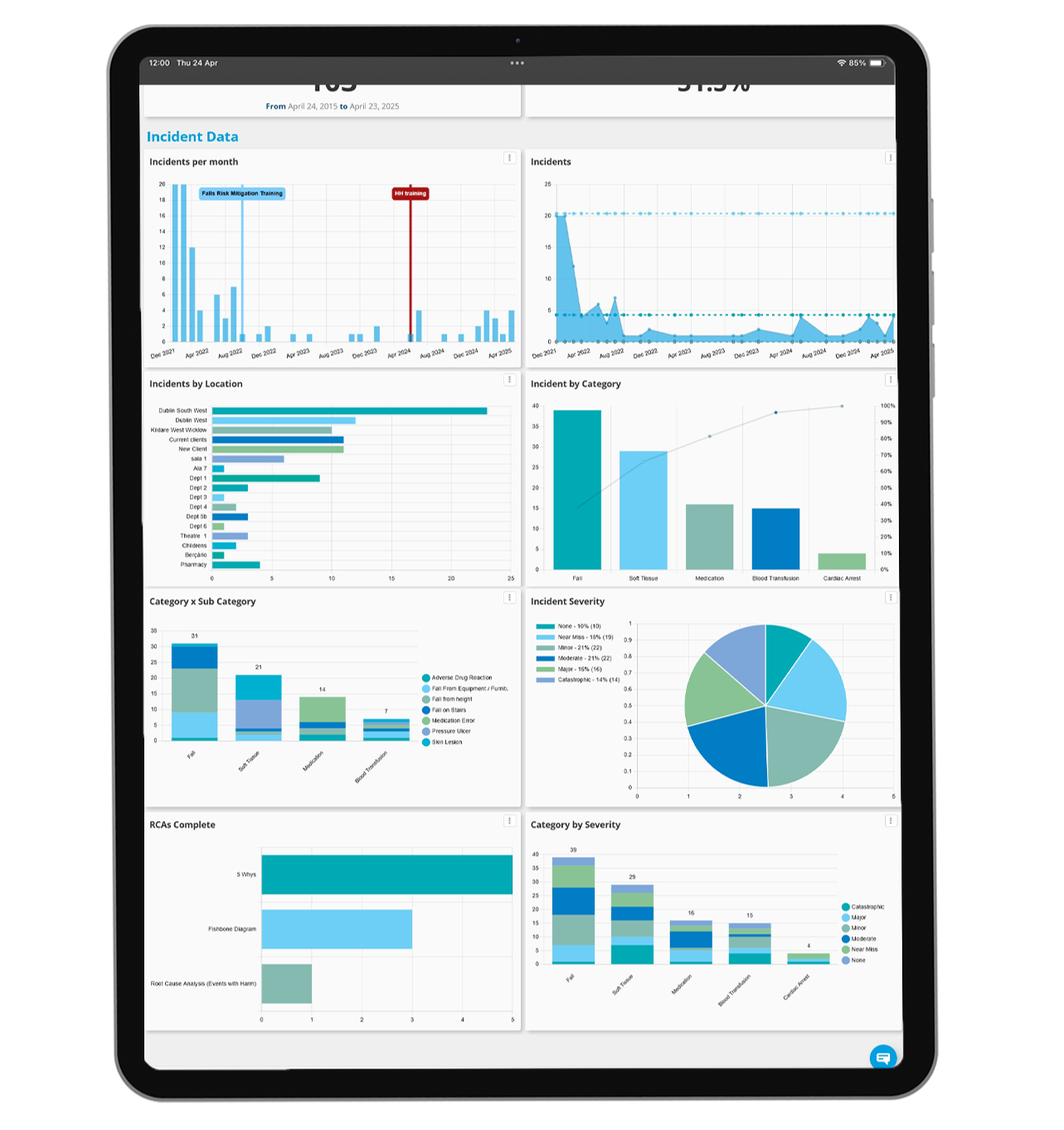
Within MEG's Incident Reporting & Risk Management solution, healthcare organisations can manage reported incidents and the information associated with their investigation within a structured digital workflow.
But the investigation itself is only one part of the process. If findings identify a new or existing organisational risk, that risk can be managed and reviewed through risk management. If a policy or procedure contributed to the incident, the relevant documentation can be reviewed through MEG Docs, with version control and approval workflows helping organisations manage subsequent changes.
Corrective and improvement actions can also be assigned to named owners through MEG's built-in action plan feature, with target dates and progress tracked through to completion.