
Effective hospital risk management is no longer just about responding to incidents after they occur. As healthcare becomes more complex, organisations need to identify and manage potential risks before they impact patient safety, staff wellbeing or operational performance.
From medication safety to regulatory compliance, hospitals face an increasing number of risks that require ongoing oversight. The challenge isn't simply recognising these risks, it's having the processes and tools in place to assess them consistently, monitor them over time and ensure appropriate action is taken.
Modern healthcare risk assessment software helps organisations move from reactive problem-solving to proactive risk management, giving governance teams greater visibility of organisational risk while supporting safer, more resilient healthcare systems.
In this guide, we'll explore the principles of effective hospital risk management, the role of a risk register and how integrated healthcare quality management software helps organisations strengthen governance and improve patient safety.
Hospital Risk Management Starts Before an Incident Occurs
Many people associate hospital risk management with investigating incidents after something has gone wrong. In reality, its greatest value lies in preventing those incidents from happening in the first place.
Risk management is the structured process of identifying potential hazards, assessing their likelihood and impact, implementing controls and reviewing them regularly to ensure they remain effective. Rather than asking "What went wrong?", effective organisations ask "What could go wrong, and what are we doing to prevent it?"
Potential risks exist across every area of healthcare, including:
Medication safety
Infection prevention and control
Clinical documentation
Workforce and staffing
Medical equipment
Information governance and cybersecurity
Patient flow and operational pressures
From Risks to Action: Building a Stronger Risk Management Process
Identifying risks is only the first step. Effective hospital risk management depends on having a structured process for assessing, monitoring and reviewing those risks over time.
This is where a real-time risk register becomes invaluable. Rather than acting as a static list of organisational concerns, a modern risk register should function as a live management tool that supports continuous improvement.
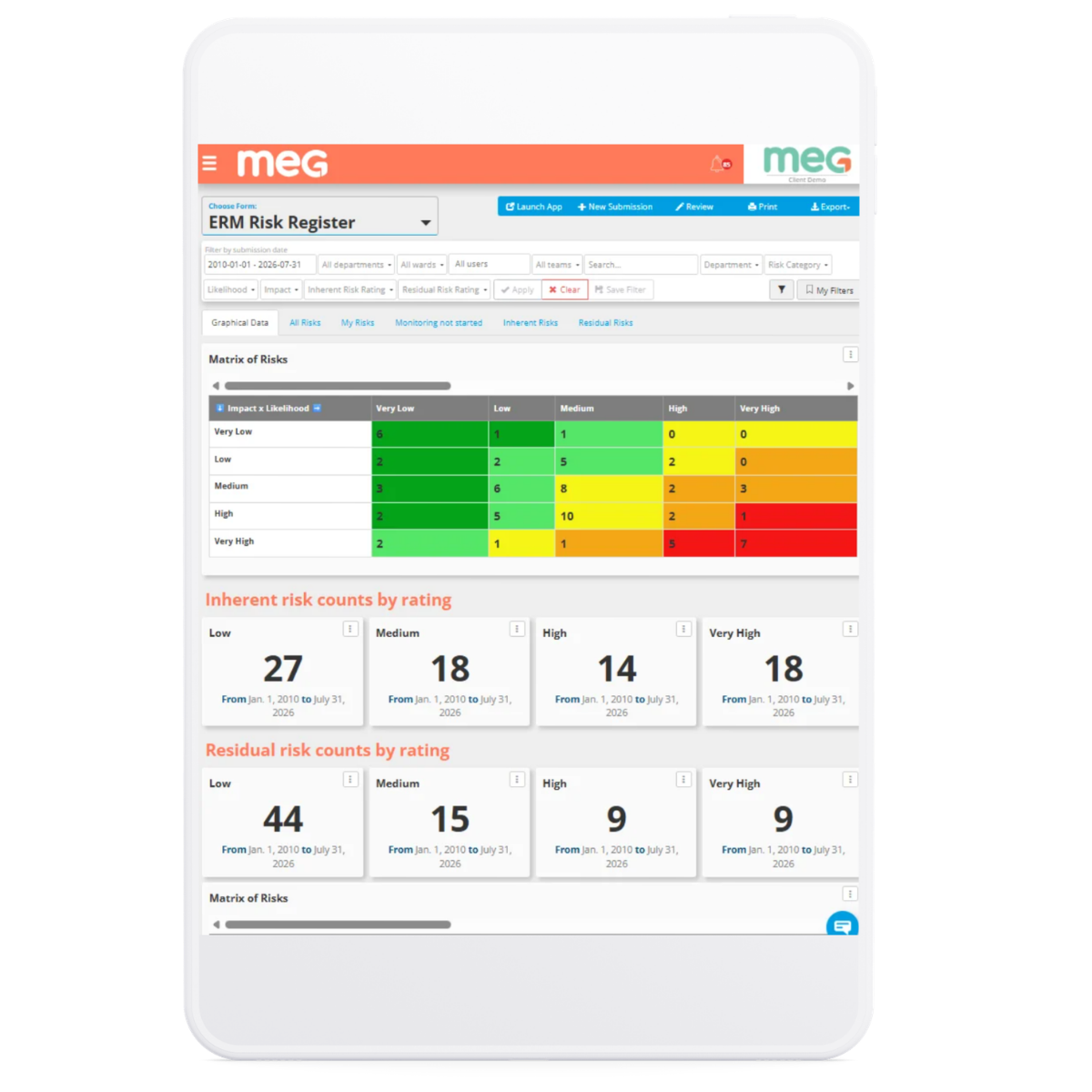
Each identified risk should be assessed using a consistent methodology, assigned to an owner and regularly reviewed to ensure mitigation measures remain appropriate as circumstances change. Scheduled reviews help organisations maintain an accurate understanding of their current risk profile instead of relying on outdated assessments.
A widely adopted approach is the use of a 5×5 impact and likelihood matrix, which scores each risk based on its potential severity and probability. This enables governance teams to prioritise high-risk issues, allocate resources effectively and maintain greater oversight of organisational risk.
How Healthcare Risk Assessment Software Supports Better Decision-Making
Healthcare risk assessment software provides a more structured approach by standardising how risks are recorded, assessed and monitored. Automated workflows reduce administrative effort while making sure that changes to a risk's impact or likelihood trigger the appropriate notifications and follow-up activities.
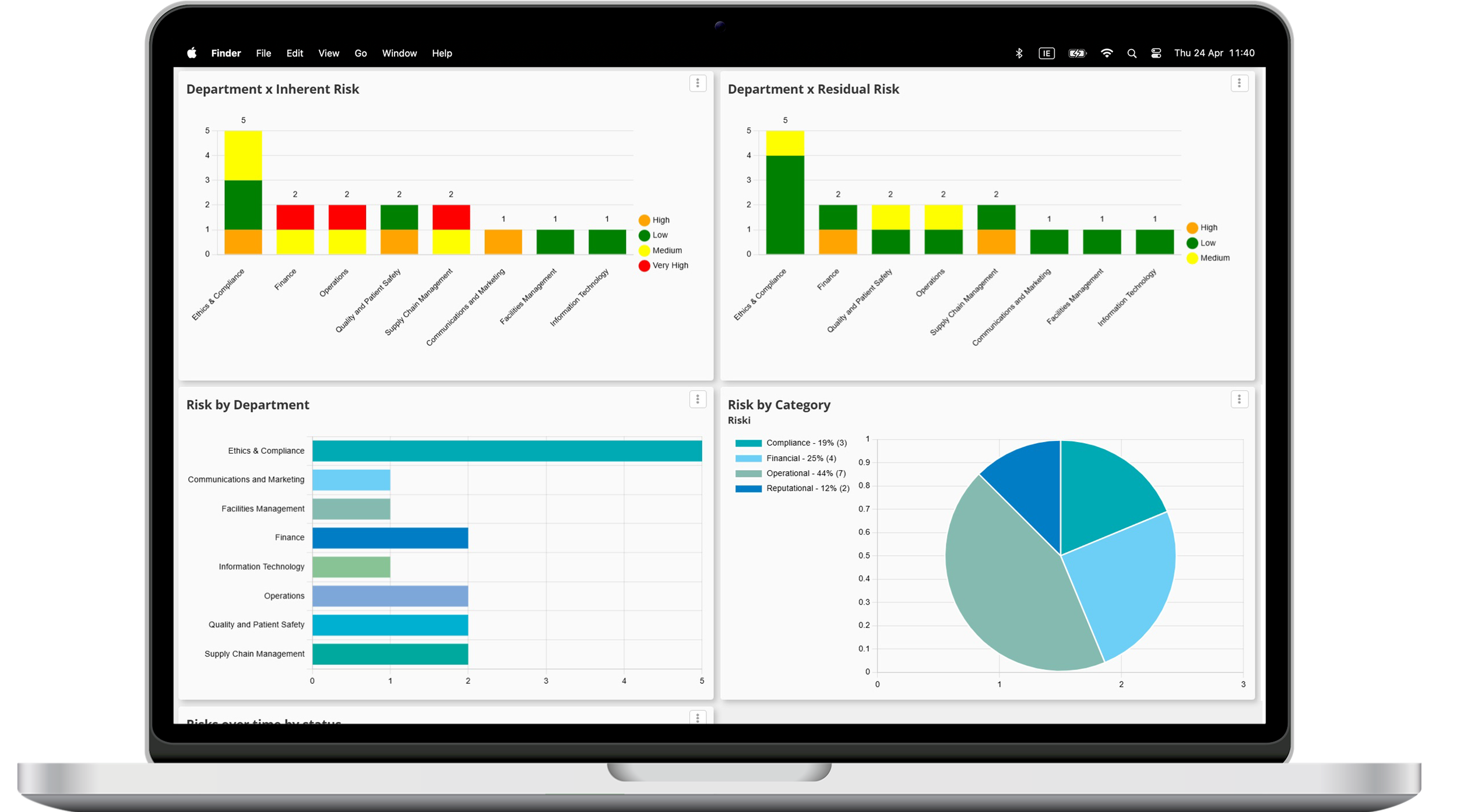
Regular review schedules help teams keep track of risks rather than being forgotten after their initial assessment, while dashboards provide leadership teams with real-time visibility of organisational risk and emerging trends.
Ultimately, the goal of healthcare risk assessment software is not simply to digitise a risk register, but to provide governance teams with the information they need to make faster, more informed decisions that improve patient safety.
How MEG Helps Hospitals Manage Risk Proactively
MEG's Incident Reporting & Risk Management solution is designed to help healthcare organisations move beyond reactive reporting and build a proactive approach to risk management.
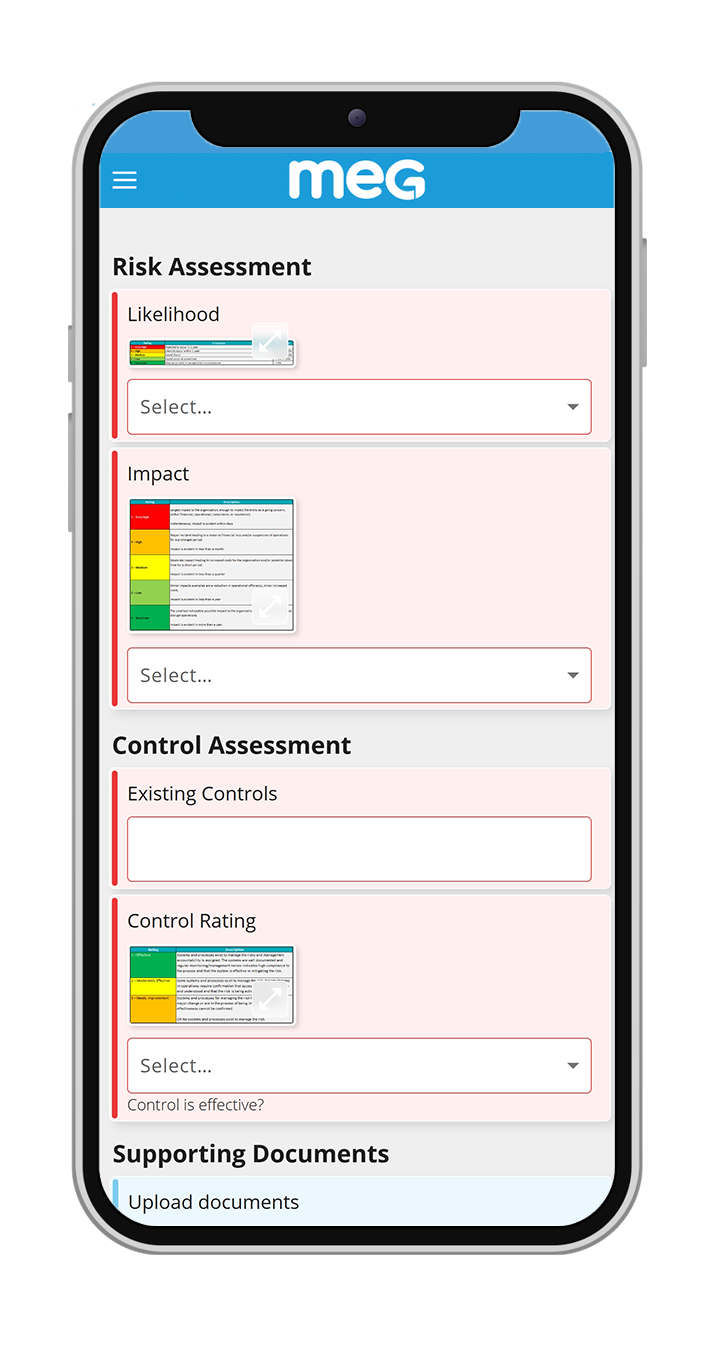
At the heart of the solution is a configurable Risk Register that enables organisations to identify, assess and monitor potential future hazards throughout their lifecycle. Risks are prioritised using a configurable 5×5 impact and likelihood matrix, making it easy for governance teams to identify high-priority risks and focus resources where they are needed most.
MEG also uses a risk tracker - which is a separate form used to keep track of risk behaviour over time, recording changes in impact and likelihood scores.
Unlike static risk registers, MEG supports scheduled reviews (e.g., monthly, quarterly) that automatically notify responsible users when a risk requires reassessment. This helps organisations keep their risk register current and helps maintain follow-up and compliance with risk management workflows.
Workflow automation further strengthens governance by automatically triggering and saving changes in the risk tracker when risk scores are updated, reducing manual administration while improving consistency.
Risk management and incident reporting are often treated as separate processes, yet they are most effective when they work together.One of MEG's unique capabilities is that a risk can be escalated to an incident or vice-versa, with pre-populated data to avoid manual re-entry.
An incident represents something that has already happened, while a risk identifies the potential for future harm. In practice, the two are closely connected. A reported incident may uncover an underlying organisational risk that requires ongoing monitoring, while an existing risk may eventually materialise into an incident despite mitigation efforts.
Connecting these processes strengthens organisational learning and reduces duplication. Rather than creating new records from scratch, governance teams should be able to escalate an incident into a tracked organisational risk, or create an incident from an existing risk record, while retaining the information already captured.
An Integrated Approach to Healthcare Governance
Risk management delivers the greatest value when it is connected to the wider quality management system.
Within the MEG platform, identified risks can trigger audits to assess compliance, generate action plans to assign and monitor mitigation activities, or prompt updates to policies and procedures through Document Management. Where an identified risk develops into an adverse event, it can be linked directly to Incident Reporting, while trends emerging from Patient Experience and Patient Complaints can help identify new organisational risks before they escalate.
This integrated approach provides healthcare organisations with a single source of truth for governance, enabling quality, risk and patient safety teams to work from connected information rather than disconnected systems. The result is stronger oversight, improved accountability and a more effective framework for continuous quality improvement.
Conclusion
Effective hospital risk management is about more than maintaining a risk register, it is about creating a culture of continuous improvement where potential hazards are identified, assessed and managed before they affect patients, staff or organisational performance.
As healthcare organisations face increasing regulatory, operational and clinical complexity, integrated healthcare risk assessment software provides the visibility and structure needed to support proactive decision-making. By connecting risk management with incident reporting, audits, action plans, document management and patient feedback, organisations can strengthen governance while demonstrating a clear commitment to patient safety.