
Recognising and responding to a deteriorating patient is a critical patient safety process and a key component of effective clinical care. Early Warning Systems such as iNEWS (Irish National Early Warning System) provide a framework to support clinical judgement and decision making when caring for acutely unwell patients. However the existence of policies and documented processes does not guarantee their consistent application in practice.
While hospitals may have adopted an EWS with escalation and response protocols, regular audit is essential to ensure timely escalation of deterioration, and compliance with national standards. Audits may include:
Accuracy of INEWS score calculation
Appropriate escalation of care
Evidence of consultant, registrar or senior clinical review where required
Completion of reassessment and repeat observations following escalation
Recognition Alone Does Not Ensure Patient Safety
Healthcare professionals already understand the clinical signs associated with deterioration. Recognition of clinical deterioration is only the first step of the patient safety pathway. Effective care depends on reliable completion of observations, accurate EWS scoring, timely escalation and clinical response.
The critical patient safety challenge that organisations face is guaranteeing that recognition, escalation and response happen reliably across different wards, shifts and patient populations.
Consider two patients who both develop an elevated Early Warning Score.
For the first patient, observations are completed on time, the score is calculated correctly, escalation occurs according to protocol and a clinical review follows promptly.
For the second, the deterioration is recognised, but escalation is delayed because the responsibility for contacting the responding clinician is unclear during a shift handover.
Although both patients were identified as deteriorating, the effectiveness of the response and associated patient safety risks are significantly different. Audits should therefore assess the entire recognition and response pathway and review trends over time to determine compliance in changing clinical environments.
Customising Deteriorating Patient Audits
Deteriorating patient pathways vary according to organisational protocols, clinical settings and the Early Warning Score systems in use. Rather than prescribing a fixed audit methodology, MEG enables healthcare organisations to configure digital audits around their own established standards and escalation processes.
Audit forms can reflect the measures an organisation needs to monitor, while supporting guidance and explanatory help text can give auditors additional context where questions could otherwise be interpreted differently. This is particularly valuable for organisations looking to apply a consistent audit methodology across multiple wards, departments or sites.
A High Compliance Score Can Still Hide a Patient Safety Risk
A deteriorating patient audit may report 92% compliance, suggesting a strong overall performance. At first glance, that sounds reassuring but a high compliance score can mask significant patient safety risks. An organisation may achieve a high overall patient deterioration score, while still experiencing delays in escalation or clinical reviews for some high risk patients.
Dashboards - Turning Exceptions Into Actionable Insights
Deteriorating patient audits can generate substantial volumes of data, particularly when they are conducted regularly across multiple clinical areas. If that information remains in individual forms or spreadsheets, recognising meaningful trends and risks is challenging as data remains in silos.
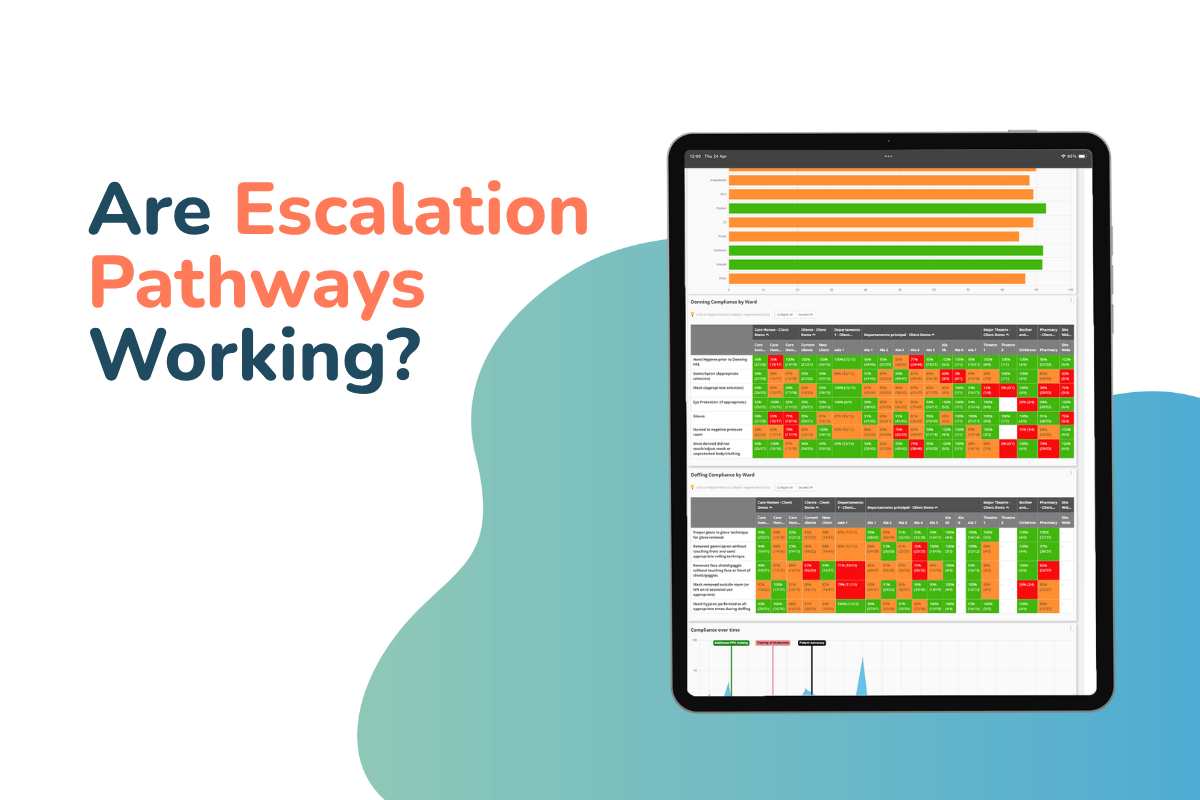
MEG’s digital reporting and dashboards allow for audit breakdown by escalation level, ward, speciality, time of day or clinical team and enable organisations to look beyond overall compliance scores. Analysis may identify delays are concentrated during shift handovers, nightshifts or within specific clinical areas. By analysing data at a more granular level, MEG identifies specific gaps, trends and process weaknesses, enabling corrective actions and quality improvements.
Rather than manually compiling audit results for a monthly governance meeting, teams can identify emerging trends, compliance gaps and investigate exceptions sooner.
That visibility becomes particularly useful when organisations need to distinguish between an isolated missed step and a recurring process problem. The objective isn't simply to create more data but to transform audit findings into meaningful and actionable insights to support safe patient care.
A well used term here at MEG and within healthcare in general is ‘You can’t improve what you’re not measuring’. Deteriorating patient auditing puts that principle into practice, while the Plan-Do-Check-Act (PDCA) cycle helps close the loop: identify an issue and plan an intervention, implement the change, measure whether it achieved the desired improvement, and then standardise what worked or revise the approach where it did not.
Connecting Deteriorating Patient Audits Across Quality Management
MEG's Audit and Compliance module enables healthcare organisations to digitise deteriorating patient audits using configurable forms that reflect their own clinical protocols and escalation pathways.
Results can be viewed through customised reporting and dashboards in real time, helping teams identify compliance trends and areas requiring further investigation rather than relying solely on manually compiled reports.
Deterioration, however, does not exist in an audit silo. If an audit identifies recurring failure to follow an escalation procedure, an action plan can assign and track the required improvement. If the procedure itself needs changing, the latest approved guidance can be managed through MEG Docs, including controlled updates and distribution.
A recurring concern can be added to the risk register for ongoing assessment and scheduled review. Where a deteriorating patient has experienced a patient safety event, the issue can also connect with incident reporting, allowing organisations to consider what incident data and audit findings collectively reveal about the pathway.
An incident tells you what happened to an individual patient.
An audit helps establish whether the expected process is being followed more widely.
The risk register identifies what requires ongoing organisational oversight.
An action plan establishes who is responsible for improvement.
Looking at these together provides a far stronger picture of deterioration management than any single dataset.
From Deterioration to Sepsis: Connecting Related Safety Signals
Deterioration is also closely connected with other patient safety priorities, including sepsis. An abnormal EWS does not diagnose sepsis, but changes in physiological observations can help clinicians recognise that a patient requires further assessment and escalation. This makes deterioration audits relevant to organisations reviewing how reliably their wider sepsis recognition and response processes operate.
The distinction is important. A deterioration audit should not become a substitute for assessing sepsis care. Instead, organisations can use related datasets to understand whether the systems designed to recognise and respond to changing patient condition are working together effectively.
Read our blog on EWS and Sepsis Detection
The Patient and Family Can Be Part of the Warning System
Recognition of deterioration should not depend exclusively on physiological observations. Patients, carers and family members may recognise that something has changed before that concern is fully reflected in a score.
A patient saying that they feel significantly worse, or a family member saying that someone is "not themselves", is information worth listening to and exploring. Effective deterioration pathways should therefore create space for concerns from patients and families to be heard and appropriately escalated alongside observations, Early Warning Scores and professional clinical judgement.
Conclusion
Effective deteriorating patient management depends on more than compliance with an Early Warning System and an escalation policy in place. Healthcare organisations need evidence that each stage of the pathway works reliably when patients need it and in a timely fashion. That means looking beyond headline compliance.
By moving beyond overall compliance score, organisations can identify where gaps exist, understand the underlying causes and target quality improvements more effectively. MEG audits support this process by providing clear and visible audit finding and trends and allows for data driven actions to improve patient safety.
MEG helps healthcare organisations move beyond simply measuring compliance to actively improving patient safety. It provides real time visibility of audits, identifies trends and can assign actions, enabling teams to identify weaknesses in the deterioration pathways, assign corrective actions and monitor improvement.